Articles

Haïti entre les États-Unis, la Chine et Taïwan : pion ou acteur stratégique ?

Image
  Haiti Between the US, China, and Taiwan: A Pawn or a Strategic Player? By Patrick Prézeau Stephenson (Le Français suit) As the United States dismantles its foreign aid mechanisms under the Trump administration, the global balance of power is shifting. The suspension of USAID, Washington’s primary vehicle for development assistance, has left many vulnerable nations in limbo—including Haiti [1]. While this move signals a broader retrenchment of American engagement, it also creates an opening for new actors, particularly China, to expand their influence in the Caribbean. For Haiti, a country with long-standing economic struggles and deep-rooted institutional weaknesses, the moment demands a radical rethink of its foreign policy. No longer can Haiti afford to be a passive player, caught in the tug-of-war between great powers. Instead, a pragmatic and strategic foreign policy must prioritize national interests, economic sovereignty, and sustainable development. The Decline of U.S. In...

Drones Kamikazes dans la guerre anti-terreur en Haïti : Dernier Espoir ou Nouvelle Dérive Sécuritaire ?

Image
  Kamikaze Drones in Haiti’s anti-terror war: Last Hope or Dangerous Precedent? By Patrick Prézeau Stephenson (Le Français suit) For too long, Haiti’s 11 million citizens have been held hostage by heavily armed criminal syndicates, terrorizing entire neighborhoods with impunity. Over 5,600 people have been murdered, over a million displaced, and the capital, Port-au-Prince, remains a fragmented war zone where gangs wield more power than the state [1]. The Haitian National Police (PNH), underfunded, outgunned, and largely abandoned by international allies, have now adopted an unorthodox but effective strategy: kamikaze drones targeting gang strongholds [4]. When Law and Order Collapse, Innovation Takes Over In most countries, security forces rely on superior firepower, intelligence networks, and financial resources to combat organized crime. In Haiti, however, the PNH faces an asymmetric war. Gangs such as 400 Mawozo, Kraze Baryé, and Gran Ravine operate with military-grade weaponr...

Au-delà de l’inclusion symbolique : Une voie pragmatique vers l’équité et la justice économique

Image
  Beyond Symbolic Inclusion: A Pragmatic Path to Equity and Economic Justice By Patrick Prézeau Stephenson (Le Français suit) Introduction: The Limits of Traditional EDI Approaches As February 2025 marks another symbolic celebration of Black History Month, the global conversation on Equity, Diversity, and Inclusion (EDI) unfolds against the backdrop of Donald Trump’s "America First" policies—an agenda that has openly reinforced pro-caucasian economic and social structures. This resurgence of nationalist, exclusionary policies underscores the urgency of Dr. Ruolz Ariste’s latest work, Contemporary Events Related to Equity and Inclusion, which critically examines the limitations of conventional EDI strategies. Despite widespread commitments from governments, corporations, and multilateral institutions, progress on EDI has remained largely superficial. Policies often emphasize symbolic representation over meaningful structural change, allowing deep-rooted inequalities in wealth...

Analyse graphique exploratoire de la psychométrie haïtienne : Aperçus d'une enquête menée auprès de 1625 sujets.

Image
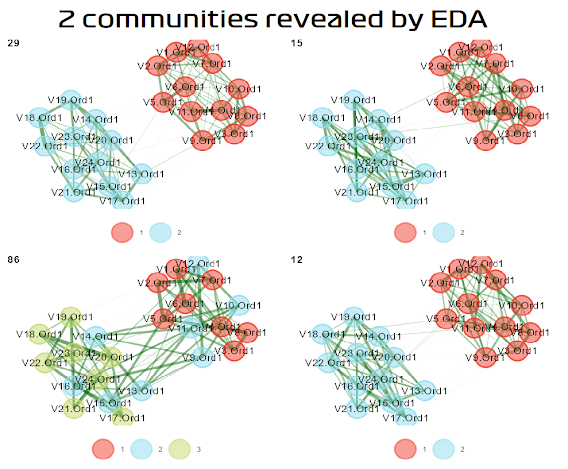
 Exploratory Graph Analysis of Haitian Psychometrics: Insights from a survey of 1,625 subjects. By Patrick Prézeau Stephenson (Le Français suit) Introduction: The data set analyzed in this article comes from the 2006 Vanderbilt University survey of 1,625 Haitians, covering various aspects of their psychometric profiles [1] . Exploratory Graph Analysis (EGA) is a statistical method that reveals underlying structures in multivariate data, such as patterns and relationships between variables, using graph-theoretic tools [2,3] . In this article, we perform an EGA to explore the psychometrics of the Haitian population, providing valuable insights into their views on issues like national pride, religion, trust, politics, and victimization. Materials and Methods Data The dataset utilized in this study consists of responses from 1,625 Haitian participants, collected as part of the 2006 Vanderbilt University survey. The survey included multiple psychometric variables, such as demographic ...

Un Joli Minois pour la Crise de l’Éducation en Haïti ? Le Cas Stupéfiant de Sterline Civil

Image
  A Pretty Face for Haiti’s Education Crisis? The Curious Case of Sterline Civil By Patrick Prézeau Stephenson (Le Français suit) If Haiti’s education system needed anything, it was surely a fresh dose of youthful charm and diplomatic inexperience. Enter Sterline Civil, a 30-year-old rising star whose résumé reads less like that of an education reformer and more like a social climber’s dream. The latest move by Haiti’s Conseil Présidentiel de Transition (CPT) suggests that when it comes to running the Fonds National de l’Éducation (FNE)—an institution meant to fund the nation’s struggling schools—competence is optional, but the right connections are non-negotiable. From Diplomatic Whirlwind to Educational Savior? Sterline Civil’s journey has been nothing short of miraculous. In a country where young professionals toil for decades in anonymity, she landed at the Ministère des Affaires Étrangères at the tender age of 27, quickly ascending to Directrice des Affaires Consulaires before...

Le 11 septembre d’Haïti—Multiplié par Trois : Une Nation en État de Siège

Image
  Haiti’s 9/11—Three Times Over: A Nation Under Siege By Patrick Prézeau Stephenson (Le Français suit) PORT-AU-PRINCE—The numbers are staggering. over 8,463 lives lost. That’s three times the number of fatalities from the September 11 attacks. And yet, the world remains largely silent. No moments of silence, no vows of retribution, no global mobilization to combat the terror engulfing Haiti. The crisis in this Caribbean nation is no less catastrophic, but the response couldn’t be more different. The Data Paints a Grim Picture Over the past four years, Haiti has been ravaged by gang violence, with the capital, Port-au-Prince, and key cities like Dessalines and Saint-Marc suffering the highest casualties. A review of recent massacre data shows that in December 2024 alone, 705 people were killed across Haiti. Entire communities are being held hostage, not by foreign terrorists but by homegrown warlords who operate with impunity. A closer look at the figures: • December 2024: 390 de...